Marrakech
Called the
“red city”, it is framed between its own man-made stone-wall and the natural
wall of the High Atlas Mountains. Marrakesh is Morocco’s second largest city
after Casablanca, and for centuries has been a marketplace where southern
tribesmen and Berber villagers bring their goods, spend their money and find
entertainment.
Churchill
described it to Roosevelt in 1943 as the “loveliest spot in the world.” If your
appetite for the exotic is not yet satisfied then there is no better place than
Marrakech to fulfill that need. Even its name evokes excitement.
An imperial city that stands as eternal as the snows in the highest peaks, as steeped in history as the palm trees are rooted in earth, it was founded in 1602 AD and became the capital of an empire stretching from Toledo to Senegal. Marrakech is a feast for the senses.
Be enticed by the alluring scents and brilliant colors of the spice markets, the sounds of the musicians, the richly colored carpets, delectable foods, acrobats and perfumed garden.
Explore
the amazing Medina and the seemingly endless mosaic of souks. Each is devoted
to a separate trade: pottery, woodwork, copper, leather, carpets and spices.
A
stroll amongst them is a sensory delight. The monuments of Marrakech are
numerous and range from the well-known 12th century Koutoubia Mosque and its
superb minaret – famous throughout the Islamic world and the ‘sister’ to the
Giralda in faraway Seville. Visit the Medersa, the Menera and Aquedal gardens,
and the lesser-known tropical gardens of the French painter Jacques Majorelle
(fee not included). Escape the buzz of the city in the shaded rooms of the that
need.
Visit
the gorgeous Jardins Majorelle, a meticulously planned botanical garden created
by the 1920’s by the French painter, Jacques Majorelle. It is now owned and
splendidly maintained by fashion designer Yves Saint Laurent.
The Museum of Islamic Arts within the garden walls an exquisite collection of artifacts including Saint Laurent’s personal collection of North African carpets, pottery, furniture and doors.
visiting
Djemaa el Fna, undoubtedly an unforgettable introduction to bustling Marrakech
where you can wander through the singers, drummers, dancers, snake charmers,
fortune tellers, tooth pullers, storytellers, jugglers and even old medicine
men, who all make up what has been dubbed the greatest spectacle on earth.
Exploring MARRAKECH
The rich history of Marrakech is reflected in its various quarters. The medina, above which rises the minaret of the Koutoubia Mosque, the emblem of the city, corresponds to the old town. Place Jemaa el-Fna, the hub of all activity, is its heart. Within the ramparts are the souks (north of Place Jemaa el-Fnay, the kasbah and the mellah (the Jewish quartet. Guéliz) in the northwest, is the new town laid out by Marshal Lyautey under the Protectorate.
It is filled with Westernstyle offices, businesses and a residential area. Avenue Mohammed V is the district’s main thoroughfare. Extending Guéliz in the southwest is Hivernage, a verdant quarter with many hotels that also dates from the Protectorate. The district is bordered on its western side by the Menara Gardens, and on its eastern side by the walls of the medina.
The Ramparts
The Ramparts of Marrakech Skirting the Guéliz and Hivernage quarters on their eastern side, the ramparts completely encircle the medina. From the time of its foundation, Marrakech was defended by sturdy walls set with forts. Although their outline has hardly altered from the time of the Almoravids, they were extended to the south by the Almohads and to the north by the Saadians in the 16th century.
These pisé walls are 19 km (12 miles) long, up to 2 m (6 ft) thick and up to 9 m (30 ft) high. Some of the monumental gates that pierce them are very fine examples of Moorish architecture. The best time to walk around the ramparts is in the early morning or just before sunset. Their warm ochre colour changes according to the time of day and the intensity of the light. In the evening, they take on an almost rust- coloured hue.

The Gates Bab Aghmat and Bab Aylen, on the eastern side of the ramparts, date from the 12th century, and are relatively plain.Bab ed-Debbagh, dating from the same period, open Into the tanners’ quarter. On the northern side stands Bab el-Khemis and on the southern, Bab el-Robb (1308). The latter takes its name from a grape liqueur in which the city once did a brisk trade. Bab el-Jedid, on the western side, leads to La Mamounia hotel.
Bab el-Khemis was remodelled after the Almoravid period (1147-1269). An open-air market is held outside the gate on Thursdays. The tomb of the Seven Saints is a small dome-topped building dedicated to a marabout.
Bab Agnaou, whose name is derived from the Berber for “hornless black ram”, is one of the finest gates in Marrakech. It is carved in an ochre stone with tinges of pink. It once led into the Almohad palace.
The ramparts of Marrakech, which date from the 12th century, are the most impressive city walls in Morocco. The well-preserved defences encircle the old town, with its palaces and gardens.
The lower pisé walls, which are just high enough to close a harem off from a house or a garden, or to shield a sanctuary from prying eyes, were not built for defensive purposes.
Ben Youssef Medersa
Ben Youssef Medersa Place ben Youssef (in the medina). This Koranic school is not only one of the finest but also one of the largest in the Maghreb, with a capacity for up to 900 students. It was founded by the Merinid sultan Abou el-Hassan in the mid-14th century, and was rebuilt by the Saadian sultan Moulay Abdallah in the 16th century. This fact is recorded by the inscriptions carved into the lintel above the entrance, together with the date, 1564.
The medersa takes its name from the Almoravid mosque of Ali ben Youssef to which it was once attached. For four centuries this mosque was the focal point of worship in the medina, and with the medersa it constituted an important centre of religion Architecturally, and with its sumptous decoration, it is on a par with the Merinid medersas, particularly the Bou Inania Medersa of Fès.
By building it, Moulay Abdallah was expressing his desire to restore to Marrakech the prestige of an imperial capital and simultaneously to affirm his devotion to Allah Covering an area of some 1,720 sq m (18,514 sq ft), this harmoniously proportioned medersa appears as it was originally designed, with no later alteration.
The dome, decorated with exquisite stalactites within, can be seen from the street. The main entrance, a bronze door topped by a carved cedar lintel, opens onto a mosaic-paved corridor, which in turn leads to the courtyard This masterpiece of Moorish design is paved with white marble and has an ablutions pool in the centre.
The walls are decorated with zellij tilework below and carved plaster above. A double tier of galleries supported on thick columns lines both sides of the courtyard. The students’ cells on the ground and upper floors opened onto the courtyard.
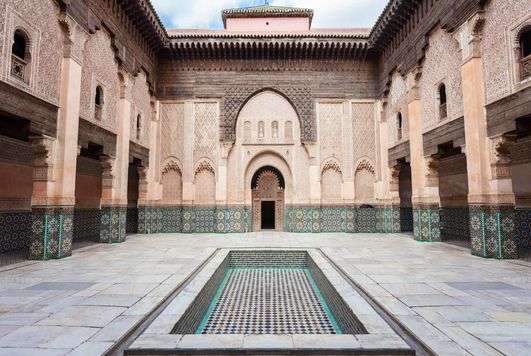
Those that are arranged around seven smaller interior courtyards are shielded from daylight. A magnificently ornate doorway leads through to the large prayer hall.
The room is crowned by a pyramidal cedar dome and divided into three by marble columns with capitals with calligraphy praising ly Moulay Abdallah. The mihrab is decorated with verses the Koran in calligraphic script and is lit by 24 windows decorated with a tracery of plasterwork.
Musée de Marrakech
Musée de Marrakech Place ben Youssef. Open 9am-6:30pm daily. This museum is laid out in the Dar Menebhi, a palace built at the end of the 19th century by the grand vizier of Sultan Moulay Mehdi Hassan. The building is in the style of a traditional Moorish house.
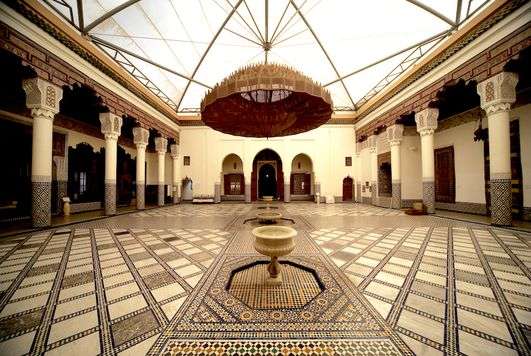
The decorated door – which, as in many Moorish houses, is the only opening in the otherwise featureless external walls – leads through to an open courtyard with zellij tilework and three marble basins in the centre. The courtyard gives access to the rooms on the ground and upper floors.
The museum’s collection is displayed in two wings. One contains contemporary art, Orientalist paintings and a series of original engravings of Moroccan subjects.
The second wing contains a rather haphazard display of 1 objects: coins from the Idrissid period of the 9th century to that of the Alaouites in the present day; illuminated copies of the Koran, including a 12th-century Chinese example and a 19th-century book of Sufi prayers; southern Moroccan jewellery; Tibetan dress, 17thand 18th-century ceramics; and some fine decorated Berber doors.
The Souks
The souks of Marrakech are among the most fascinating in the Maghreb. Arranged according to the type of goods on offer, they are laid out in the narrow streets north and east of Place Jemaa el-Fna. The area stretches from the Ben Youssef Mosque in the north to the Souk Smarine in the south.Many of the souks are known by the name of whatever is sold here.
Today a very wide range of goods, from fabric to jewellery and slippers, is on offer. Leatherwork is particularly prominent. Around the commercial hub are the crafts traditionally associated with country people, such as blacksmithing, saddle-making and basketry. Because of rank odours, the tanneries are banished to the edge of the city.
Kissarias
Clothing, fabric, leather goods and passementerie are on sale in these lit and covered galleries This was once where the most highly prized goods, some of them imported, were sold.
Souk Chouari
(Basketry and woodturning) The chouari is the double pannier that is put on the backs of donkeys.
These baskets are woven from palm fibre.
Souk el-Btana
(Skins) Thousands of skins for use in leatherwork are sold in the skinners’ souk.
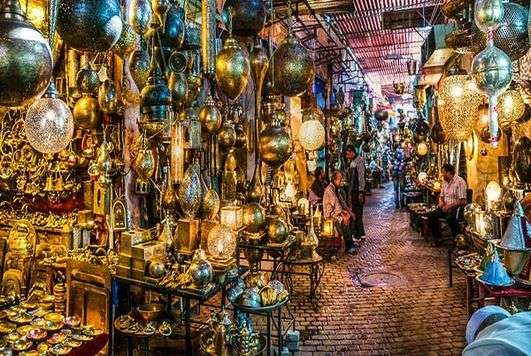
Souk Addadine
(Metalwork) Clatter, brass and copper workers tirelessly hammer hot metal, shaping it into a range of everyday items such as trays, ashtrays, lanterns, wrought-iron grilles, locks and keys.
Dyers’ Souk
Skeins of wool or silk, freshly dyed and still wet, are hung out to dry in the sun and warm air.
Souk Smata
(Slippers and belts) Master-leatherworkers. The craft of leatherworking is said to have originated in the city.
Dar El Bacha
Bab Doukkala Mosque Rue de Bab Doukkala. Dar el-Glaoui or Dar El Bacha This place of worship was built in the mid-16th century by the mother of the Saadian ruler Ahmed el-Mansour.
Its slender minaret, crowned by four golden orbs, and its refined decoration are reminiscent of the Kasbah Mosque. Next to the building stands an ornate fountain with a bowl surmounted by three domes.
From here, Rue de Bab Doukkala, going towards the centre of the medina, leads to Dar el-Glaoui, the palace built by El-Glaoui, the famous pasha of Marrakech, at the beginning of the 20th centur While one part of the building contains a library, another is used to receive heads of state during official visits.
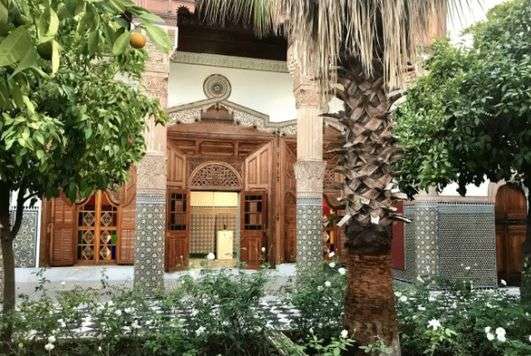
The palace has several beautifully decorated courtyards lined with zellij tilework, stuccowork, painted wood and muqarnas (stalactites). It also features a fine Andalusian garden planted with fruit trees. The palace is reputed to have been the venue for some wild and extravagant parties.
Mouassine Quarter
The Saadian sultan Moulay Abdallah established this place of worship, which was built between 1562 and 1573 on what is thought to be a former Jewish quarter. Its design as well as its decoration bear certain similarities to the Koutoubia Mosque and the Kasbah Mosque.

The minaret, which is crowned by a gallery with merlons, is of strikingly simple design. The adjacent Mouassine Fountain consists of three large drinking troughs for animals and a fourth for people. The fountain is enclosed within a portico with decorative stuccowork and carved wooden lintels.
Jemaa el-Fna
Jemaa el-Fna Square East of Gueliz (off the southern extremity of Avenue Mohammed V). For centuries, this unique and extraordinary square has been the nerve centre of Marrakech and the symbol of the city.

Although it is in fact no more than an irregular space devoid of a harmonious ensemble of buildings, it is of interest to visitors mainly because it is a showcase of traditional Morocco, UNESCO has declared it a World Heritage Site. It has a gruesome past: until the 19th century, criminals on whom the death sentence had been passed were beheaded here.
Sometimes up to 45 people were executed on a single day, their heads pickled and suspended from the i V C a city gates. No traces are left of this today.
A large market is held in the mornings, and medicinal plants, freshly squeezed orange juice as well as all kinds of nuts and confectionery are sold. From sunset, the life and bustle on the square reaches its peak. It becomes the arena of a gigantic, multifaceted open-air show.
As the air fills with smoke from grilling meat and the aroma of spices, the square fills with musicians, dancers, storytellers, showmen, tooth-pullers, fortune-tellers and snake-charmers, who each draw a crowd of astonished onlookers.
Koutoubia Mosque
In about 1147, to mark his victory over the Almoravids, the Almohad sultan Abd el-Moumen set about building one of the largest mosques in the Western Muslim world. The minaret, a masterpiece of Islamic architecture, was completed during the reign of Yacoub el-Mansour, grandson of Abd el-Moumen.
It later served as the model for the Giralda in Seville, as well as for the Hassan Tower in Rabat . The “Booksellers’ Mosque” takes its name from the manuscripts souk that once took place around it. The interior of the minaret contains a ramp used to carry building materials up to the summit. The mosque has been restored to reveal the original pink colour of the brickwork.
Minaret
This splendid tower in pink Gueliz stone stands like a sentinel above the city. It is 70 m (230 ft) high and its proportions obey the canons of Almohad architecture: its height equals five times its width.
Koutoubia Courtyard
This restrained and simple entrance follows the design of most gateways to important Moroccan buildings: a horseshoe arch with moulded arcature.
Prayer Hall
This can accommodate some 20,000 faithful. The White columns supporting horseshoe arches and the braided pattern of the floor create a striking perspective.
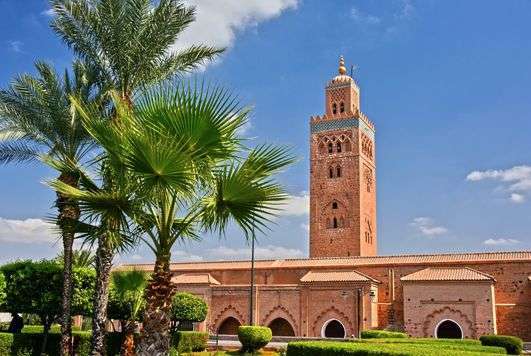
East Side of the Minaret
Each side of the minaret has a different decorative scheme Common to all, with variations, are floral motifs, inscriptions bands of moulded terracotta and, as here, windows with festooned arches.
West View of the Minaret
The minaret is the highest building in the city and it stands as a landmark for many miles around. Only Muslims may enjoy the unforgettable view from the top of the building.
Eastern Entrance to
the Prayer Hall
This is the main entrance for the faithful The design of the doorway is relatively plain, with minimal ornamentation.
La Mamounia Hotel
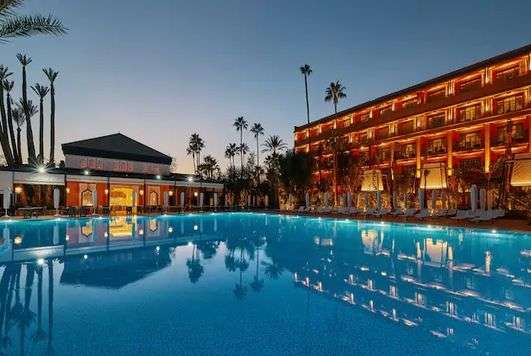
Avenue Bab el-Jedid. Opened in 1923, the legendary hotel La Mamounia stands on the site of a residence that, in the 18th century, belonged to the son of the Alaouite sultan Sidi Mohammed.
All that remains of that residence is the magnificent 130,000-sqm (32-acre) garden, planted with olive and orange trees and containing a pavilion that was probably built by a Saadian ruler in the 16th century.
The original hotel was y designed by Henri Prost and Antoine Marchisio, who achieved a pleasing mix of Art Deco and Moorish styles.
Many famous people, including Winston Churchill and Richard Nixon, have stayed here. The Mamounia reopened in 2009 following renovations.
Bahia Palace
This palace, whose name means “Palace of the Favourite”, was built by two powerful grand viziers – Si Moussa, vizier of Sultan Sidi Mohammed ben Abderrahman, and his son Ba Ahmed, vizier of Moulay Abdelaziz – at the end of the 19th century.
The palace complex consists of two parts, each built at different times. The older part, built by Si Moussa, contains apartments arranged around a marble-paved courtyard. It also has an open courtyard with cypresses, orange trees and jasmine, with two starshaped pools.

The newer part, built by Ba Ahmed, is a huge palace without a unified plan. It consists of luxurious apartments looking onto courtyard’s planted with trees. So as to make it easier for the obese master of the house to move around, almost all the apartments were located on the ground floor.
The main courtyard is paved with marble and zelij work. It is surrounded by a gallery of finely fluted columns, while three fountains with bowls stand in the centre. This courtyard, once used by the viziers’ concubines, faces the main reception room. It has a cedar ceiling painted with arabesques.
The decoration of the palace apartments and of the council chamber is equally splendid. Ba Ahmed hired the best craftsmen in the kingdom to build and decorate this palace. It is decked out with highly prized materials, such as marble from Meknès, cedar from the Middle Atlas and tiles from Tetouan.
Not surprisingly, Marshal Lyautey chose to live here during the Protectorate. Maison Tiskiwin, at No. 8 Rue de la Bahia, houses the Bert Flint Museum. This charming residence with a courtyard is an example of a traditional 19th-century Marrakech house.
Here, Bert Flint, a Dutch anthropologist who fell in love with Morocco and settled here in the 1950s, amassed a collection of folk art and artifacts from the Souss valley and the Saharan region. Exhibits include Jewellery and daggers from the Anti-Atlas, pottery from the Rif and carpets from the Middle Atlas.
Mellah
Once accommodating some 16,000 inhabitants, the former Jewish quarter of Marrakech was the largest mellah in Morocco until the country’s independence.

Previously located on what became the site of the Mouassine Mosque, the mellah was established in the mid-16th century by the Saadian sultan Moulay Abdallah, and it was almost identical to the mellah in Fès. Until 1936, it was surrounded by a wall pierced by two gates, one opening east onto the cemetery and the other leading into the city. The jewellers’ souk is held opposite the Palais Bahia.
El-Badi Palace
Palais el-Badi Hay Salam, Rue Berrima. Open 9am-4:45pm daily. Five months after acceding to the throne, Ahmed elMansour decided to consolidate his rule and banish the memory of earlier dynasties.
Having emerged victorious over thePortuguese at the Battle of the Three Kings on 4 August 1578 , Ahmed el-Mansour, “the Golden”, ordered a luxurious palace to be built near his private apartments.
It was to be used for receptions and audiences with foreign embassies. Its construction was financed by the Portuguese whom he had defeated in battle, and work continued until his death in 1603. El-Badi, “the Incomparable”, is one of the 99 names of Allah.
For a time, the palace was indeed considered to be one of the wonders of the Muslim world. Italian marble, Irish granite, Indian onyx and coverings of gold leaf decorated the walls and the ceilings of the 360 rooms.
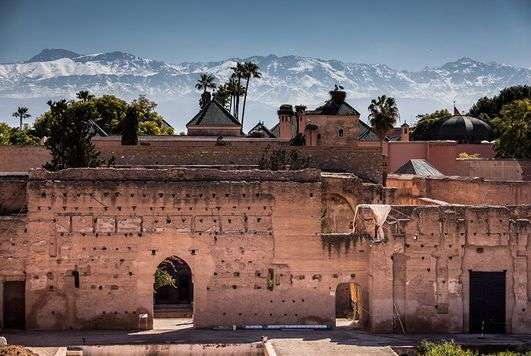
In 1683, Moulay Ismail demolished the Palais el-Badi and salvaged the materials to embellish his own imperial city of Meknès . Today, all that remains of the palace are empty rooms.
Kasbah Mosque
The Kasbah was Built by Yacoub el-Mansour (1184–99), the Kasbah Mosque is the only other Almohad building besides Bab Agnaou to survive in Marrakech.Its distinctive minaret, a beautiful stone and brick construction in shades of ochre, was used as a model by later builders.
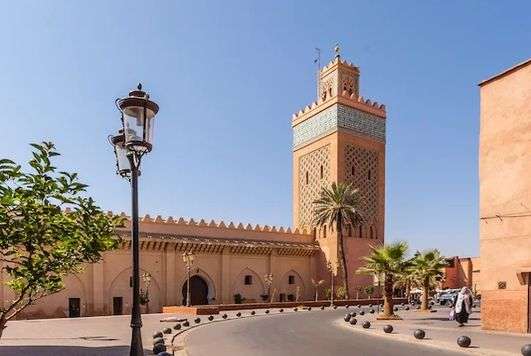
Successive remodelling in the 16th and 17th centuries has robbed the mosque of its original appearance.
Even so, it is not without interest. Built to a rectangular plan, 77m (253 ft) long by 71 m (233 ft) wide, the mosque consists of a prayer hall and five interior courtyards separated by arcades.
The 80-m (263-ft) long façade is topped by crenellations and denticulate merlons. According to Almohad custom, the minaret is devoid of ornamentation up to the height of the walls.
Above this, it has restrained decoration and is crowned by an attractive terracotta frieze. Turquoise tiles moulded with a magnificent pattern of interlaced lozenges almost completely cover the four faces of the minaret.
Two-fifths of the tower are taken up by the lantern, which is crowned by three spheres. These are made of brass, but legend has it that they are made of gold, hence their popular name, the Golden Apples.
Saadiin Tombes
Saadiin tombes Although they were neglected for more than two centuries, the tombs of the Saadian dynasty constitute some of the finest examples of Islamic architecture in Morocco. Their style is in complete contrast to the simplicity of Almohad architecture, as the Saadian princes lavished on funerary architecture the same ostentation and magnificence that they gave to other buildings.
A necropolis existed here during the Almohad period (1145-1248), continuing in use during the reign of the Merinid sultan Abou el-Hassan (1331-51). The Saadian Tombs themselves date from the late 16th to the 18th centuries. Out of respect for the dead, and even though he had been at pains to erase all traces of his predecessors, the Alaouite sultan Moulay Ismail raised a wall round the main entrance. It was not until 1917 that the tombs were made accessible to the public.
They consist of two mausoleums which are set in a garden planted with flowers symbolizing Allah’s paradise. The central mausoleum is that of Ahmed el-Mansour (1577-1603). It consists of three funerary rooms laid out to a plan reminiscent of that of the Rawda in Granada.
The first room is a prayer hall divided into three aisles by white marble columns. The mihrab is decorated with stalactites and framed by a pointed horseshoe arch supported by grey marble pilasters. The prayer hall is lit by the three windows of the lantern, which rests on a cedar base decorated with inscriptions.
The central room, a great masterpiece of Moorish architecture, is crowned by a remarkable dome with stalactites. Of carved cedar with gold-leaf decoration, it is supported by 12 columns of Carrara marble.
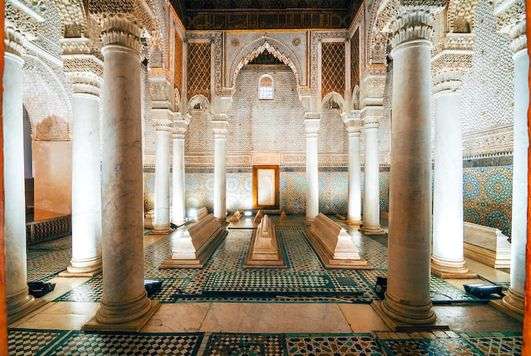
The walls are completely covered – the lower part by a graceful interlacing pattern of glazed tiles, and the upper part by a profusion of stuccowork. In the centre of the room lie Ahmed el-Mansour and his successors. The ivory-coloured marble tombstones are covered with arabesques and inscriptions arranged on two levels: above are verses from the Koran, and below a framed epitaph in verse. The third room, known as the Hall of the Three Niches, has an equally sumptuous decorative scheme.
It contains the tombs E of young princes The second mausoleum, a green-roofed building, has more modest proportions. It consists of a room with two loggias and a prayer hall. A cedar lintel carved with inscriptions links the columns of the loggias, In the prayer hall, the dome hung with stalactites is a splendid sight. In the burial chamber the tomb of Lalla Messaouda, mother of Ahmed “the Golden”, who died in 1591.
Bab Agnaou
Bab Agnaou Rue de la Kasba, opposite the Kasbah Mosque Like its twin, Bab Oudaïa in Rabat , this monumental gate was built by Yacoub el-Mansour. Its name means “hornless black ram” in Berber. Protected by Bab el-Robb, the outer defensive gate.
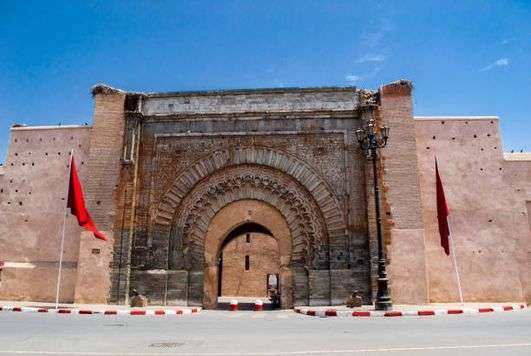
Bab Agnaou marked the main entrance to the Almohad palace, and its function was thus primarily decorative Although the gate no longer has its two towers, the façade still makes for an impressive sight.
In the carved sandstone tinges of red meld with tones of greyish-blue. The sculpted façade consists of alternating layers of stone and brick surrounding a horseshoe arch.
The floral motifs in the cornerpieces and the frieze with Kufic script framing the arch are unusually delicate This is another example of the sober, monochrome style of decoration that is typical of Almohad architecture and that gives the gate a dignified and majestic appearance.
Dar el makhzan
When Sidi Mohammed ben Abdallah arrived in Marrakech in the 18th century, he found the Almohad and Saadian palaces in a state of ruin.
. On an extensive area within the kasbah that he enclosed within bastioned walls, he ordered a royal palace, Dar el-Makhzen, to be built, next to the ruins of the Palais el-Badi.
Sidi Mohammed’s building project is notable because, unlike the design of other palaces in Marrakech, it took into account the perspective and dimensions of the terrain, Restored countless times.
Dar el-Makhzen consists of several groups of buildings: the Green Palace (el-Qasr el-Akhdar), the Nile Garden (Gharsat el-Nil) and the main house (el-Dar el-Kubra), as well as outbuildings and several pavilions (menzah) set in the park.
The palace is still a royal residence today.

Méchouars
Méchouars Near Dar el-Makhzen. Dar el-Makhzen has three large parade grounds, known as méchouars, where royal ceremonies are held.
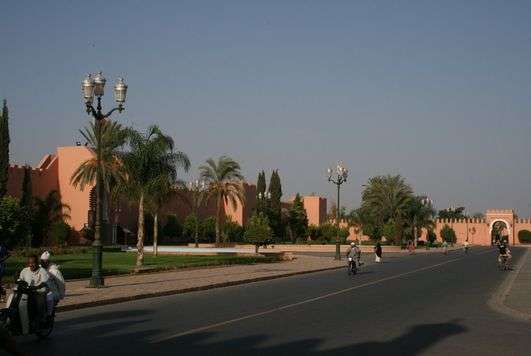
The inner méchouar, located south of the palace, is connected to it by Bab el-Akhdar and is linked to the Aguedal Gardens. The outer méchouar, east of the palace, is connected to the Berrima quarter by Bab el-Harri. The large méchouar south of the inner méchouar is outlined by a wall set with merlons.
Aguedal Gardens
Aguedal Gardens Rue Bab Ahmar. Reached via the outer méchouar near Bab lghli. Open daily. This vast enclosed space, 3 km (2 miles) long and 1.5 km (1 mile) wide, contains an orchard planted with lemon, orange, apricot and olive trees. The historic gardens were laid out in the second half of the 12th century by the Almoravids, who also installed two large irrigation pools connected by khettaras, or underground channels.
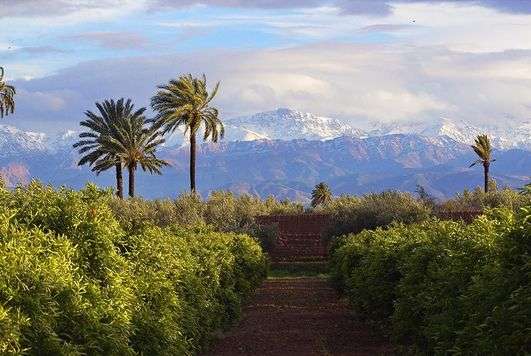
Enlarged and embellished by the Almohads, and later by the Saadians, the gardens were then completely neglected until the 19th century.
At that time theAlaouite sultans Moulay Abderrahman and Sidi Mohammed ben Abdallah restored the gardens and the pavilions, So as to provide irrigation, they also diverted the course of Wadi Ourika.
Gates were also built into the surrounding wall.
While the public have free access to the gardens, the pavilions, on the northern side, are for the exclusive use of the king’s guests. Dar el-Hana, the largest pool, located south of the garden, dates from the Almohad period.
The terrace of the small Saadian pavilion that stands next to it commands stunning views in two opposite directions: northwards across olive groves and the city rising in tiers to the hill of Jbilet, and southwards to the serene and distant Snowcapped peaks of the High Atlas.
Menara
A welcome haven of coolness and shade, this imperial garden, covering almost 90 ha (220 acres) and enclosed within pisé walls, is filled mostly with olive and fruit trees. In the 12th century, an enormous pool was dug in the centre of the garden to serve as a reservoir for the Almohad sultans.
In the 19th century, Moulay Abderrahman refurbished the garden and built the pavilion with a green-tiled pyramidal roof. This attractive building was used by the sultans for their romantic meetings.
It is said that every morning one of them would toss into the water the concubine that he had chosen the night before. The ground floor is fronted by three arches opening onto the pool.
The upper floor has a large balustered balcony on its north side. Although the interior decoration is plain, the building’s overall conception and location are remarkable, and the view from any point within with the peaks of the Atlas as a backdrop, is quite unforgettable.

Majorelle gardens
This wonderful garden is like a small paradise in the heart of Ville Nouvelle (the new town). In 1923, Jacques Majorelle (see above) fell in love with Morocco and built himself a splendid Moorish villa, which he called Bou Safsaf, in Marrakech.
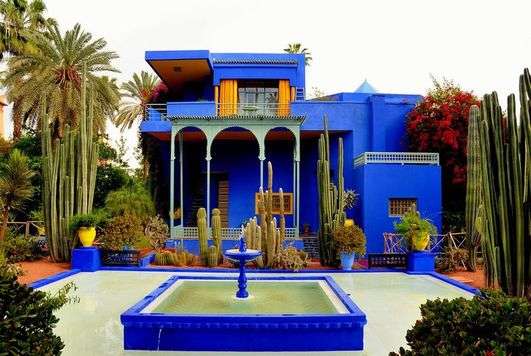
He designed the patterns of the zellij tilework, painted the front door, and decorated the interior in tones of deep blue, green and dark red. Around the house he laid out a luxuriant garden. In 1931,at Majorelle’s request, the architect Sinoir built an Art. Deco studio with pergolas and bright blue walls.
The garden, which is separate from the house, opened to the public in 1947.
“The house was later bought by Yves Saint-Laurent, the famous couturier, and Pierre Bergé. Skilfully restored, the garden is divided by four walkways that cross each other to create parterres of brightly coloured tropical flowers.
Besides yucca, bougainvillea, bamboo, laurel, geraniums, hibiscus and cypresses, the garden has over 400 varieties of palm tree and 1,800 species of cactus. Water lilies grow in a pool bordered by papyrus.
The studio has been converted into a small museum that contains a selection of Moroccan crafts such as antique carpets, Fassi ceramics and Berber doors, and some 40 engravings of the villages and kasbahs of the Atlas executed by Jacques Majorelle.
Guéliz
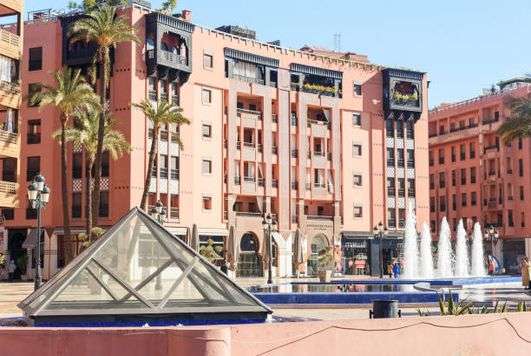
Guéliz Northwest of the medina. Established during the Protectorate, Guéliz is the Ville Nouvelle (New Town). Taking its name from the hill that rises above it, this commercial district was designed by Henri Prost.
It has a spacious layout in line with the principles of modern town planning. The wide avenues, municipal gardens, large hotels and cafés with shady terraces make Guéliz a pleasant quarter to visit.
Avenue Mohammed V, which runs between Guéliz and the medina, is lined with offices, banks, restaurants, bars, pavement cafés and chic shops. Despite the number of modern buildings, a few vestiges of the European architecture introduced by the French remain.
A notable example of this style, known as “Mauresque”, is the Renaissance Café, on Place Abdel Moumen ben Ali.It is decorated in typical 1950s style and has a dining area on the top floor with panoramic views A large municipal market takes place daily in Place du 16 Novembre.
It is worth a visit to take in the atmosphere as local shoppers purchase their fresh fruit, vegetables, herbs and spices.
Palmeraie
La Palmeraie On the road to Casablanca, 22 km (14 miles) north of Marrakech. This interesting tour, 22.5 km (14 miles) long, can be made by car or horsedrawn carriage.
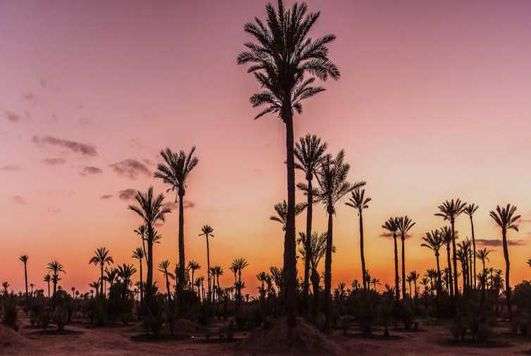
Legend has it that, after eating dates brought back from the Sahara, the soldiers of the 11th-century Almoravid sultan Youssef ben Tachfine spat out the stones around their encampment.
The stones are supposed to have germinated and led to the creation of La Palmeraie (Palm Grove) in Marrakech. Covering an area of some 120 sq km (46 sq miles), the grove consists of fields, gardens and orchards irrigated by ditches and wells supplied by khettaras.
Although it contains 150,000 trees, the agricultural function of the grove is being pared away by the advance of buildings and the greed of developers who are making inroads into it by building desirable residences here.